Wednesday, 12 December 2012

Some Teifi recovery news

Back to Teifi news before the next installment of our Costa Rica trip.
This Oystercatcher with a deformed bill that we controlled in Newport back in October was ringed as a pullus in 2008 at Lingley Green, Warrington by Leigh Ringing Group. That name rang a bell and then we realised it was the group of our friend Dr Richard Charles who travelled to Uganda with us.
Another close connection was a  3J Reed Warbler that John Hayes from Pembs RG ringed in Pembroke on 22nd July and it traveled north 48km to us 31 days later.

Our first control Cetti's Warbler in Oct 2012 was ringed in Nov 2011 at Farlington Marsh, Portsmouth. It will be interesting to see if either of us catch it in the breeding season.

Two other recoveries of our birds were a Chiffchaff  ringed by us in Sept 2011 and caught at Sandwich Bay estate, Kent this September and a juv Sedge Warbler ringed by us on the 14th August 2012 and caught 14 days later at Squires Down, Dorset.

Monday, 10 December 2012

Deeper into the rainforest


Half an hour in a boat took us to our next place to stay, Cano Palma where we caught this stunning Royal flycatcher mentioned in a previous blog.Cano Palma is the Canadian biological station  for COTERC
It is the fifth site that has been part of the Tortuguero Integrated Bird Monitoring Programme since 1994.
We were fortunate in being accomodated in this characterful thatched house on stilts.
We were welcomed as part of the team which included being on the cooking and cleaning rota. Luckily Richard was on a team with two girls who loved cooking! The volunteers were very enthusiastic about ringing with us in between their other activities of turtle and herp monitoring.
 Some birds ringed there included Cocoa Woodcreeper
 Chestnut-backed Antbird
 Tennessee Warbler
 
Chequer-throated Antwren
 
  Kentucky Warbler
 and a Northern Waterthrush (at the ringing table with Ian and Peter, two of the Canadian volunteers)
Each net round was an adventure walking through the lush vegetation
 
Like at Tortuguero, the day wasn't just about ringing. We also helped with Shorebird surveys walking along the beach to where the canal opened into the sea and seeing some good species including Willet, Collared Plovers, Greater Yellowlegs and Franklins gulls.
 
 Going anywhere from base was by canoe or kayak which we eventually mastered.
 
Plenty of reptiles were about, the most colourful being these tiny strawberry poison-dart frogs (Dendrobates pumilio)
and some larger green frogs

 But then the rain started
.............. and continued with 137mm in one 12 hour period! The water rose until the boats were floating on the boat deck (brief video). On the pre-dawn of leaving day we packed in the darkness of a powercut and the water was over the top of our wellies as we waded for the boat.
Even that couldn't spoil our brief stay in this wonderful location and we left for the next step in our adventure with a yearning to return.

Sunday, 9 December 2012

Ringing in the rainforest

Back to the UK after a fascinating 4 weeks ringing in Costa Rica so here is the first episode of the adventure so far.  Richard is there for another month so more to follow in the New Year.
We started the trip in Tortuguero, a remote community situated on a landmass which overlooks both the Caribbean ocean and the fresh water river, Rio Suerte. The region has an average temperature of 71 degrees Fahrenheit year round, with a high amount of precipitation and humidity. Costa Rica Bird Observatories have been conducting research there since 1994.
We were based at the Sea Turtle Conservancy 
 but five sites are operated in the area. With no roads this means either going by boat along the canals
 or loading the back pack and walking a couple of kilometres.
 
  
The first morning we caught an exciting bird - a White-eyed Vireo. The textbooks describe only 2 previous records for Costa Rica!
Unfortunately the rain started in full flow that week and curtailed our ringing sessions. And people say Wales is wet. Just listen to this clip of rain!
 Some birds we caught between the downpours were this Red-capped Manakin
with bright yellow thighs
 a Northern Barred Woodcreeper
American Pygmy Kingfisher
 Western Slaty Antshrike
as well as several American Migrants including Chestnut sided and Kentucky warblers, Swainson's, Gray-cheeked and Wood thrushes and Grey Catbirds.
Some other wildlife we encountered that week -
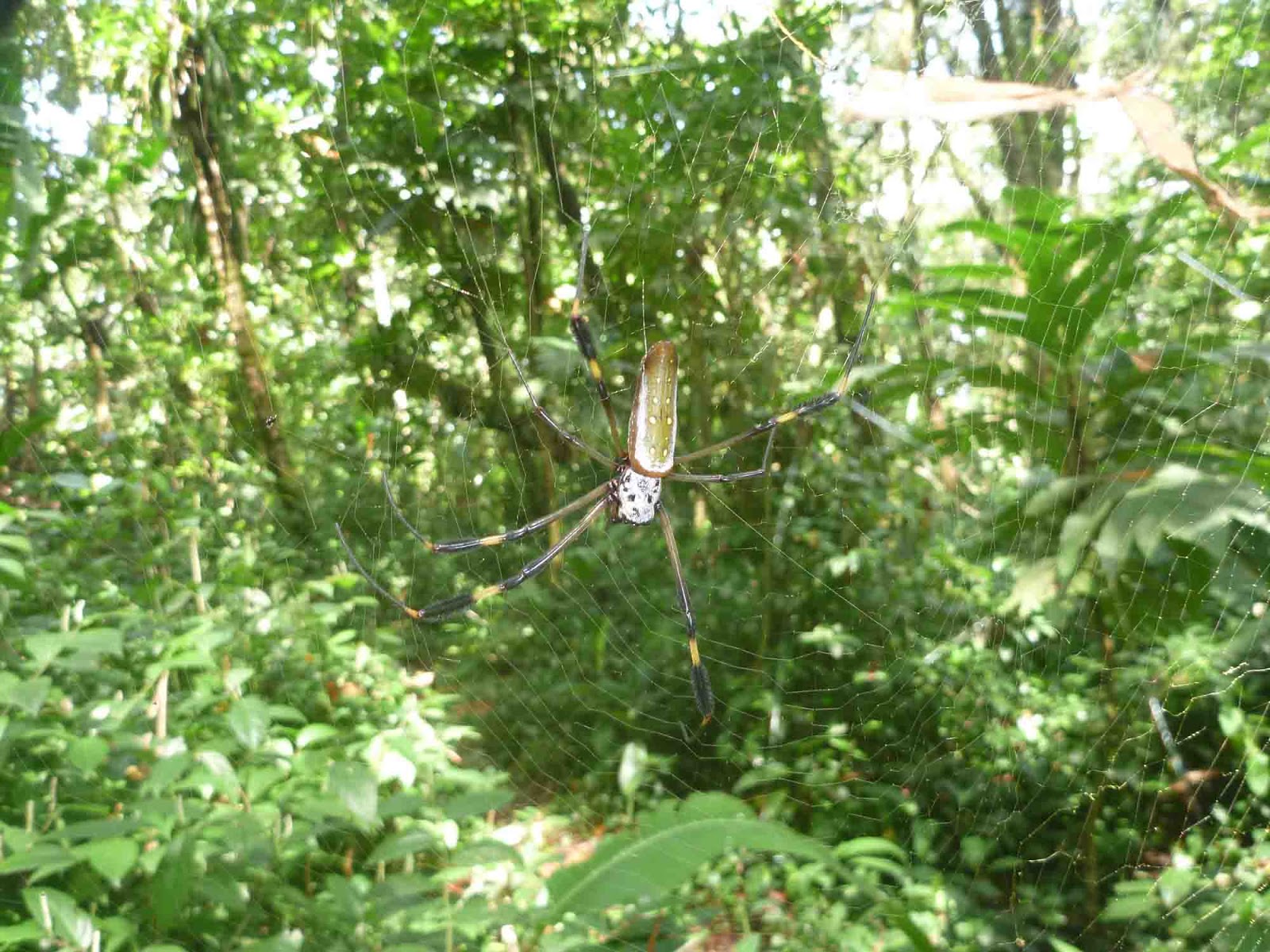
Golden Orb spiders who can spin an incredibly tough web across a net lane overnight to catch unsuspecting ringers as we put up nets pre-dawn.
Large,colourful Iguanas wandered around the STC garden
 and of course the hatchling turtles for which the area is famous, scurrying out to sea for the first time
with Black Vultures watching and hoping for an easy snack.
As well as ringing we also carried out area searches recording all birds seen and heard. Migration counts every 2 hours involved a 10 minute count of flyover migrants every 2 hours from the beach.
Although the main migration period was over, we were still counting reasonable numbers of Barn Swallows, Ring-necked Ducks and Turkey Vultures.
Next installment tells of our move to Cano Palma, flooding and rainforest birds including a stunning Royal Flycatcher.

Sunday, 25 November 2012

Redwings and firecrest

While Richard and Wendy are away ringing in Costa Rica, Karen and Dawn undertook their first 'solo' ringing session in the Teifi Marshes. Once we'd figured out how to use 'repeat' on the MP3 player we were delighted with 5 Redwing in the evening and another 3 in the morning. Also caught were a Song Thrush and a continental style Blackbird.

On our second attempt we only managed 1 Redwing after putting the nets up ready for the following morning only to be defeated by the rain. This morning we tried again with 1 more Redwing, 4 Goldcrest and a Firecrest!

If it ever stops raining before Wendy returns who knows what we may find............


Wednesday, 21 November 2012

A Royal Flycatcher before more rain

As we write this, 137mm rain recorded in the last 12 hours!
Yes, it is the rainy season in Tortuguero, Costa Rica, one of the wettest places in the world.
Between the downpours we have managed plenty of banding at three different sites so far. In our first session  we caught a White-eyed Vireo, only the 3rd record for Costa Rica.
And then this......
A Royal Flycatcher, a difficult species for birders to find let alone a performing male in the hand.
We are here to capture and study  resident birds to further the knowledge of moult etc. Like the Vireo, North American migrants form the majority of captures eg four species of North American thrushes in  one session.
Whilst helping with Shorebird counts and general migration monitoring various other species which according to literature are excellent for the Caribbean coast include Black Skimmers, Franklin's Gulls and Yellow-throated and Palm Warblers.
Our last day tomorrow in the Caribbean lowland tropical rain forest before heading to the central mountains for a whole new range of species - and weather!
(Rich and Wendy)

Saturday, 27 October 2012

Willow Warbler arrives in SA, we migrate to CR

No ringing for us today .... but Malcolm in South Africa is doing nicely. He caught his first Willow Warbler of the year in his Johannesburg garden.
During January/ February 2012 we went ringing in Uganda with Malcolm (African Affinity Birding) - a fantastic time. See the posts we made in February when we returned from the trip for more !

On 7th November, Wendy and I head abroad again, this time to Costa Rica. We will be ringing and monitoring birds as part of the US Forest Service long term studies and will fit as much birding in as possible in our spare time! Our main bases will be on the Caribbean coast at Tortuguero and 2,500m up in the mountains at Madre Selva.

Our homework is filling our evenings.....


Hopefully some more ringing before we go, otherwise updates when we can from Costa Rica !

Saturday, 20 October 2012

Teifi to Gower....Redpoll to 221 Oystercatchers

Last night's reward, only one Lesser...but our first in autumn...a nice adult male.

Today to Gower -
The annual visit to continue the study of Burry Inlet Oystercatchers.
With equipment provided by Steve Dodd and the SCAN Wader Group. We were not disappointed with a 221 bird catch today, slightly earlier than high tide.
With a good catch like this, one team to ring and one team to process -
The processing team with -
 Rachel measuring wing length and moult scoring, C J (Chris) measuring head to bill tip and bill depth, Charlie weighing each bird and Graham recording the detail.
Of the 221 bird catch - 198 new and 23 retraps from previous years, one a likely control from North Wales.
Due to great positioning of the nets (recces by Graham on Friday), only one of three nets was used..
The photo below shows the  roost site with the two nets in position that were not used.