A good mix of species were caught during a short session on the Teifi Marsh on Saturday including a Chiffchaff, Blackcap, Songthrushes, Goldcrests and Blackbirds. This is the latest date that a Blackcap has been caught on the reserve although overwintering birds have been ringed in gardens before.
The group have only ever caught 4 Lesser Redpolls so to have ringed over 20 this month is noteworthy. We also retrapped a male that was ringed on the reserve last year - here he is when ringed last October.
Some news from the BTO of recoveries of some of our birds.
Out of the 235 Siskins ringed in my garden earlier this year there have been two recoveries so far.
One Siskin ringed last March was caught at Lake Vyrnwy in
Powys in July and was seen several times on the feeders so possibly bred there. Another Siskin ringed in February was caught 45 days and 366km later in April in Stocksfield, Northumberland.
Also news of the original ringing details of 2 controls caught on the Teifi Marsh. A Sedge Warbler caught on 16th May 2013 was ringed in Tour aux Moutons, Loire Atlantique, France on 23rd August last year on its first migration south.
And this Sedge Warbler...
that we caught on 26th June 2013 was ringed on 10th August 2012 at La Claire Mere, Guernsey.
Weather for the week looks like ringing will be limited so a catch up of some more Costa Rica birds in the next blog.
We are a group of bird ringers based on the North Pembrokeshire and South Ceredigion border at the Teifi Marshes near Cilgerran, also North Carmarthenshire. Stories of our members ringing experiences home and away
Sunday, 17 November 2013
Saturday, 16 November 2013
Boa before Black-throated Trogon
530am - Another Boa found by a Alfredo and Alberto, our night-time naturalist security guards. We were just about to catch our boat to Tortuga Lodge, but this six foot Boa delayed us.
The legs were going to the beach - surveying Green Turtle nests......!
With numbers of migrants well down now, our attention is back to the study of resident birds. We start with this wing moult....
Yes, the wing belongs to a wren....a Stripe-breasted Wren. Not a familiar moult pattern, but an example of the symmetrical and sometimes asymmetrical moult patterns that resident birds have here.
The star bird of the day appeared to have replaced one central tail feather. Presumably through accidental loss ?
Does the green on the outer edge of this newly replaced central tail feather indicate this is a young male..?
This is the bird, a juvenile Black-throated Trogon ......the bird of our day.
A wet morning with heavy tropical downpours, and since our last visit three net rides lost to fallen trees.
This is net ride 13. When a tree falls here, others come down too, creating a great hole in the canopy through which sunlight or rain pours down...often at the same time !
The recent rains have filled the forest floor with lizards and poisonous Strawberry Poison-dart Frogs....
Hundreds of frogs and lizards leaping about as the water rose. If the rains continue, and net rides continue to disappear, this maybe my last visit to Tortuga Lodge.....
..........Until next year.......
The legs were going to the beach - surveying Green Turtle nests......!
With numbers of migrants well down now, our attention is back to the study of resident birds. We start with this wing moult....
Yes, the wing belongs to a wren....a Stripe-breasted Wren. Not a familiar moult pattern, but an example of the symmetrical and sometimes asymmetrical moult patterns that resident birds have here.
The star bird of the day appeared to have replaced one central tail feather. Presumably through accidental loss ?
Does the green on the outer edge of this newly replaced central tail feather indicate this is a young male..?
This is the bird, a juvenile Black-throated Trogon ......the bird of our day.
A wet morning with heavy tropical downpours, and since our last visit three net rides lost to fallen trees.
This is net ride 13. When a tree falls here, others come down too, creating a great hole in the canopy through which sunlight or rain pours down...often at the same time !
The recent rains have filled the forest floor with lizards and poisonous Strawberry Poison-dart Frogs....

..........Until next year.......
Friday, 15 November 2013
Back to Reality
Just to show that we who were left to hold the fort for the last two months haven't been entirely idle, here are a few of the 17 Lesser Redpolls that were ringed during our last session on the Teifi Reserve a few days ago.
Ageing and sexing Redpolls isn't always easy by any means, so this was a very good opportunity to refresh our skills. The two above were an adult female and an unsexed '3', i.e. a bird fledged this year; with their colouration enriched by the light of the rising sun.
No one could be in any doubt about this adult male though, resplendent in his freshly moulted plumage - and by far the brightest of the bunch.
Thursday, 14 November 2013
Costa Rica Highland birds
Back to the world of internet and a catch up of what we have been up to in the last 2 weeks at Madre Selva in the Talamanca Mountains of Costa Rica. Our base at 2,500 metres has 3 ringing sites each slightly different in habitat. Compared to our time on the Caribbean coast we caught few migrants and those that we did were mainly species that spend the winter in the lightly forested farmland
like Wilson's Warblers
and Black-throated Green Warblers.
One unexpected migrant to find in a net though was this Broad-winged Hawk
Among the resident birds that we saw but didn't catch on our last visit was this Paltry Tyrannulet shown in the Lakeside habitat where it is found.
Collared Redstarts are frequently seen around the lake too
Along with Black-capped Flycatchers
Olive-striped Flycatchers
and Flame-throated Warblers.
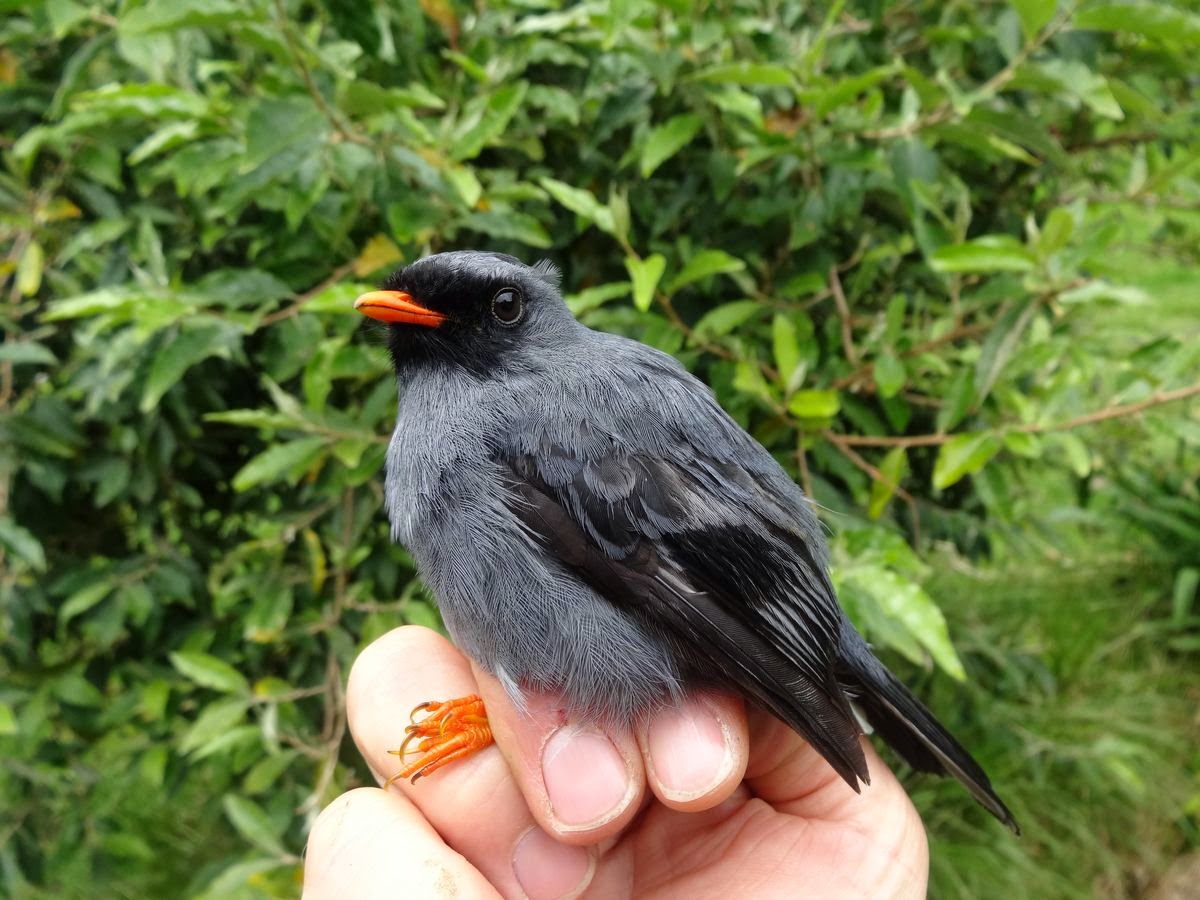
Some birds that we caught that were more often heard than seen in the forest included Black-faced Solitaire with a far-carrying flutelike song
Sooty-capped Bush-Tanager
Common Bush-Tanager
Large-footed Finch, both juvenile
and adult,
Ruddy Treerunner
Chestnut-capped Brush-Finch
Spotted Barbtail
the aptly named Yellow-thighed Finch,
and Spot-crowned Woodcreeper
The species we caught most of at Madre Selva was Ruddy-capped Nightingale Thrush
Some more Highland specialities in the next blog.....
like Wilson's Warblers
and Black-throated Green Warblers.
One unexpected migrant to find in a net though was this Broad-winged Hawk
Among the resident birds that we saw but didn't catch on our last visit was this Paltry Tyrannulet shown in the Lakeside habitat where it is found.
Along with Black-capped Flycatchers
Olive-striped Flycatchers
and Flame-throated Warblers.
Some birds that we caught that were more often heard than seen in the forest included Black-faced Solitaire with a far-carrying flutelike song
Sooty-capped Bush-Tanager
Common Bush-Tanager
Large-footed Finch, both juvenile
and adult,
Ruddy Treerunner
Chestnut-capped Brush-Finch
Spotted Barbtail
the aptly named Yellow-thighed Finch,
and Spot-crowned Woodcreeper
The species we caught most of at Madre Selva was Ruddy-capped Nightingale Thrush
Some more Highland specialities in the next blog.....
Before the highlights of the Costa Rican Highlands.......
Wendy, just home from catching 110 species in Costa Rica will post some photos and describe this year's adventure into the last part of our trip - the Highlands.
Her final bird in the hand though, was this juvenile Prevost's Ground Sparrow, a great little find at InBio in San Jose, our final ringing site together.
Meanwhile Ivan and I have just arrived back in Tortuguero - to the expected rain and swollen canals of the Caribbean lowland forests.
Ivan, a ringer and researcher from Spain joined us about a month ago and will ring with me until I leave on 10th December. Here Wendy and Ivan sharing the cooking on the fine wood-burning stove at our recent Highland base.
Highland highlights next..........
Her final bird in the hand though, was this juvenile Prevost's Ground Sparrow, a great little find at InBio in San Jose, our final ringing site together.
Meanwhile Ivan and I have just arrived back in Tortuguero - to the expected rain and swollen canals of the Caribbean lowland forests.
Ivan, a ringer and researcher from Spain joined us about a month ago and will ring with me until I leave on 10th December. Here Wendy and Ivan sharing the cooking on the fine wood-burning stove at our recent Highland base.
Tuesday, 29 October 2013
Forty days in the rainforest, Talamanca mountains next...
Today was our final day ringing in the lowland Caribbean Forest. Tortuga Lodge our final venue and it gave us a great send off with three new species for the trip.
First was this seven inch male Green Kingfisher, one of three kingfisher species caught and of five species seen in the lowlands. Tennessee Warbler and Thick-billed Seedfinch the other two new species.
We don't often catch the adult male White-collared Manakin, but one today. This species is the most commonly caught resident - 73 our final total.
We caught more Swainson's Thrushes than any other migrant species, with 502 ringed. Thrushes made up a large proportion of our numbers --208 Veery and 158 Gray-cheeked in the total of 1568 birds caught, but we did ring 73 species. Below a Swainson's Thrush, and like all the thrushes, different races were recorded.
We haven't really mentioned flycatchers, and Costa Rica has over 70 species, we caught 14 of them !
This Great Kiskadee was rather smart..
Another nice flycatcher, this Great-crested Flycatcher.......
During our 40 days ringing...a few breaks
- To be invited on a 3 hour pelagic was great and some close up views of Brown Boobies and other seabirds, this a Royal Tern resting on drifting wood.
We lived next to18 miles of turtle nesting beach which produced several species of waders with small numbers seen most days. This a Willet.
Tortuguero's famous Green Turtle nesting beach...with c180,000 nesting visits being made this year !
More on turtles when Wendy is home...we did spend four hours one night with the turtles - quite amazing....and....a stunning photo of a female Green Turtle returning to sea after egg laying with a few words by Ralph - our "Turtle Man"
"The raw beauty of Tortuguero is unmatched by any other place I have ever been. If you are looking for white sand beaches where you can sit under shade and sip a cocktail with a miniature umbrella, it may be best to skip Tortuguero. But, if you are looking to quench that desire to feel alive, I believe this may be your place."
Ralph Pace, Field Research Co-ordinator
At our next location in the Highlands at 2400m, we guess we may have poor internet service, here is the link to our previous visit last November ...
...a taste of...Madre Selva
First was this seven inch male Green Kingfisher, one of three kingfisher species caught and of five species seen in the lowlands. Tennessee Warbler and Thick-billed Seedfinch the other two new species.
We don't often catch the adult male White-collared Manakin, but one today. This species is the most commonly caught resident - 73 our final total.
We caught more Swainson's Thrushes than any other migrant species, with 502 ringed. Thrushes made up a large proportion of our numbers --208 Veery and 158 Gray-cheeked in the total of 1568 birds caught, but we did ring 73 species. Below a Swainson's Thrush, and like all the thrushes, different races were recorded.
We haven't really mentioned flycatchers, and Costa Rica has over 70 species, we caught 14 of them !
This Great Kiskadee was rather smart..
Another nice flycatcher, this Great-crested Flycatcher.......
During our 40 days ringing...a few breaks
- To be invited on a 3 hour pelagic was great and some close up views of Brown Boobies and other seabirds, this a Royal Tern resting on drifting wood.
Tortuguero's famous Green Turtle nesting beach...with c180,000 nesting visits being made this year !
More on turtles when Wendy is home...we did spend four hours one night with the turtles - quite amazing....and....a stunning photo of a female Green Turtle returning to sea after egg laying with a few words by Ralph - our "Turtle Man"
"The raw beauty of Tortuguero is unmatched by any other place I have ever been. If you are looking for white sand beaches where you can sit under shade and sip a cocktail with a miniature umbrella, it may be best to skip Tortuguero. But, if you are looking to quench that desire to feel alive, I believe this may be your place."
Ralph Pace, Field Research Co-ordinator
At our next location in the Highlands at 2400m, we guess we may have poor internet service, here is the link to our previous visit last November ...
...a taste of...Madre Selva
Sunday, 27 October 2013
Costa Rica latest - more residents than migrants...
The peak of migration seems to be over with only 8 migrants banded today including our 50th Northern Waterthrush.
The emphasis turned to ant related birds at Cano Palma station in the forest.
A Caiman's eye view.....
as we arrive at Cano Palma for dawn after a 20 minute boat ride along the canals of Tortuguero.
The Caiman himself....
Back to the resident birds, the highlights today being 4 Chestnut-backed Antbirds, 2 Western-Slaty Antshrikes and this female Chequer-throated Antwren.
From Antwrens to Wood-Wrens....
2 White-breasted Wood-Wrens were caught today.
These are one of the most tuneful dawn songsters along with Stripe-breasted Wren.
Only two days banding left on the Caribbean coast before we head to San Jose and then the Highlands for 2 weeks. Our last banding sessions will be at our two other primary forest sites in the hope of studying more resident birds and also wonderful forest butterflies and moths...
Also other residents such as these Ghost Crabs who live in holes in this coastal forest floor.
From ghosts to phantoms...... seems right to show this picture again of this beautiful translucent forest butterfly, the Blushing Phantom.
Off to Parque Nacional de Tortuguero pre-dawn with a forecast temperature of 24°c at 5am for our one mile walk.....
The emphasis turned to ant related birds at Cano Palma station in the forest.
A Caiman's eye view.....
as we arrive at Cano Palma for dawn after a 20 minute boat ride along the canals of Tortuguero.
The Caiman himself....
Back to the resident birds, the highlights today being 4 Chestnut-backed Antbirds, 2 Western-Slaty Antshrikes and this female Chequer-throated Antwren.
From Antwrens to Wood-Wrens....
2 White-breasted Wood-Wrens were caught today.
These are one of the most tuneful dawn songsters along with Stripe-breasted Wren.
Only two days banding left on the Caribbean coast before we head to San Jose and then the Highlands for 2 weeks. Our last banding sessions will be at our two other primary forest sites in the hope of studying more resident birds and also wonderful forest butterflies and moths...
Also other residents such as these Ghost Crabs who live in holes in this coastal forest floor.
From ghosts to phantoms...... seems right to show this picture again of this beautiful translucent forest butterfly, the Blushing Phantom.
Off to Parque Nacional de Tortuguero pre-dawn with a forecast temperature of 24°c at 5am for our one mile walk.....
Subscribe to:
Posts (Atom)