Friday, 10 November 2017

September and October at Fygyn Common and Ffynnon Gro

I called my last post "Fygyn..... developing a new ringing site". I thought this time I would summarise the results from both my sites Fygyn Common and Ffynnon Gro for the months of September and October.
This year I have had fewer ringing sessions abroad and have had more time to ring at Fygyn Common in particular, the months from August to September producing some interesting birds and caught some new birds for this site as well.

Fygyn Common Totals


Species
New
Re-traps
Totals
Sparrowhawk
1

1
Green Woodpecker
1

1
Swallow
41

41
Tree Pipit
2

2
Meadow Pipit
115

115
Grey Wagtail
1

1
Wren
3
1
4
Dunnock
7
6
13
Robin
5
3
8
Stonechat
2

2
Blackbird
2

2
Song Thrush
1

1
Redwing
1

1
Grasshopper Warbler
1

1
Chiffchaff
14

14
Goldcrest
21
3
24
Long-tailed Tit
1

1
Willow Tit
1
7
8
Coal Tit
4
5
9
Blue Tit
33
9
42
Great Tit
11
8
19
Chaffinch
38
5
43
Goldfinch
7
6
13
Siskin
7
5
12
Bullfinch
8
1
9
Reed Bunting
4
1
5
Totals
332
60
392

The highlights of the ringing sessions at Fygyn Common were:-


The Green Woodpecker was a first for Fygyn Common and a new bird for me. It was totally unexpected even though I have seen a number of them about and have investigated with ringing friends and on the internet the best way to catch them. Within a few days of each other I also caught a male Great Spotted Woodpecker from my garden site at Ffynnon Gro 


This year has been the best since I started to ring at Fygyn Common for Grasshopper Warblers. The first to be caught was on 20/04/17, in total 12 birds were ringed 6 juveniles and 6 adults. 
I strongly suspect they have been breeding at the site.


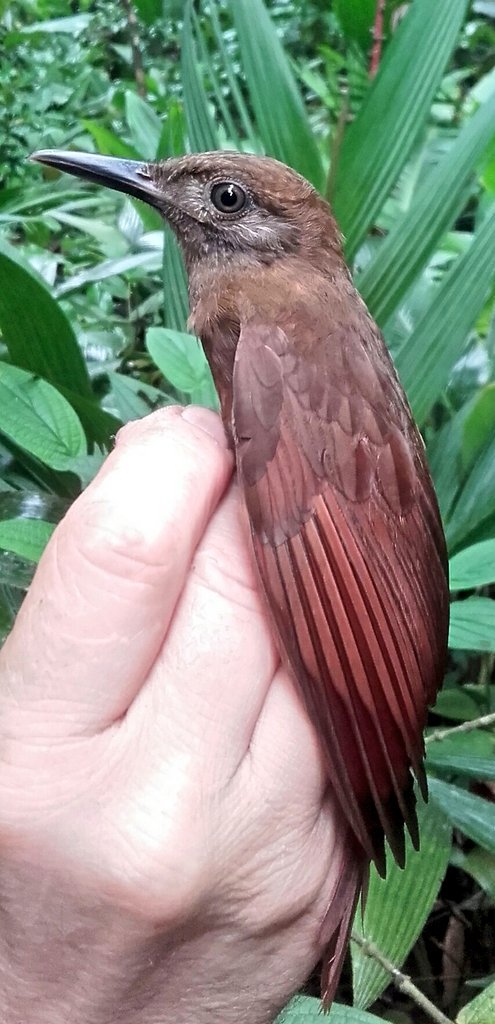
The last bird caught was on 02/09/17 and was this scraggy looking adult above and as with some of the other birds they were probably on migration passage.


Not big numbers but 6 Tree Pipits have made a presence again this year, all juveniles. Again probably have bred on the site. They were first heard calling by Karen Meatyard from the Teifi Group in late Spring when she came to ring with me. 


More success with Meadow Pipits. They started to arrive in late August and increased in numbers and 115 being caught for September and October. The last bird caught was 30/10/17 and brought the total to 151 birds this year.


This picture just gives you some comparison between a Tree Pipit and a Meadow Pipit
Tree Pipit claw 6mm - 9mm, Stronger supercilium and bill is thicker and stumpier
Meadow Pipit claw 10mm - 13mm, weaker supercillium and the bill is finer.


First for the site this Grey Wagtail


My first Stonechat was caught in 2013 in a spring trap, many attempts since then has caught Robins but no more Stonechats but 2 birds were caught in mist nets this year, the one above in September.

        Ffynnon Gro Totals


Species
New
Re-traps
Totals
Great Spotted Woodpecker
1

1
Swallow
3

3
Wren
1

1
Dunnock
1
2
3
Robin

2
2
Blackbird
1
1
2
Mistle Thrush
3

3
Redwing
78

78
Chiffchaff
1

1
Goldcrest
2

2
Marsh Tit
2
2
4
Long-tailed Tit
3

3
Willow Tit
3

3
Coal Tit
7

7
Blue Tit
28
5
33
Great Tit
22
2
24
Nuthatch
1

1
House Sparrow
5

5
Chaffinch
10
1
11
Goldfinch
36
13
49
Siskin
4
5
9
Totals
212
33
245
                                                                                 
The highlights of the ringing sessions at Ffynnon Gro were:-


This male Great Spotted Woodpecker caught on 28/10/17 was a juvenile,  looking closely at its head you can still see some red juvenile feathers that have not moulted.


3 new Mistle Thrush have been caught in October which brings the total to 4 birds for this year and a total of 7 birds for the site.


Redwing, regular every year have shown up in bigger numbers with a total of 78 new birds, site total this year being 151. All the birds have been caught in my High Flyer and still birds fly over the top of the nets. Another project coming on I think.

Many thanks to all members of the Teifi Ringing group that came along to help this year and especially the last couple of months:- Karen Meatyard, Dawn Jay, Arfon Williams, trainee's Molly Heal, Andrew Hughes and Katie Dix. Their presence has given opportunities to increase the number of nets used and experiment netting arrangements in new areas. I enjoy their company and it's nice to have like minded people ringing with you.

I am looking forward and hoping that I may have Firecrest and YellowBrowed warbler this winter. Goldcrest have started to show on Fygyn Common. Woodcock and Snipe have also started to arrive, so catching any of these species would be special.

Pura Vida - Costa Rica

We have returned from the Highlands to San Jose from where we are taking a two day birding break to La Fortuna on the Lowland Caribbean slope.
A few species to finish our two months of birding and banding for Costa Rica Bird Observatories.
Where migrants meet residents in the Highlands


Flame-throated Warbler, a resident.


An adult male Golden-winged Warbler, a migrant. Always amazing to see the species above together in the field or in a mist net.


This Gray-cheeked Thrush a scarce bird outnumbered by the Swainson's Thrushes here at 2400m.


Plenty of pollen on this juvenile Mountain Gem sp, but this season the Highland's shrubs seemed to be later in flowering and fruiting.


The smallest Hummingbird  species we ever see - this a 2.3g adult female Scintillant. The eight-ish species of Hummingbirds that we find around our Highland station really are like the Tits at home in Wales.


A male Lesser Violetear, previous name Green Violetear, a very vocal species.


A juvenile Slaty Flowerpiercer, a species often in combat with the hummers at flowers.


Both Wendy and I gave talks on behalf of Costa Rica Bird Observatories, the BTO and the San Vito Bird Club and helped at the VIth Partners In Flight Conference in San Jose, where we met some of the main Pan American researchers from both the academic and observatory world.


The theme of Wendy's presentation.


We led bird walks for 5 mornings in the local park, managing to find a total of 53 species by day 5. Following the conference Eric and Laura, researchers from Mexico joined us for two days at Madre Selva.


We were also joined by fellow Brits for some pre-breakfast banding...Paul and Rachael Eele, pictured  above with their guide.


A juvenile Barred Forest-Falcon.


An adult Yellowish Flycatcher, two species banded after Paul and Rachael left us....but Paul did process a Ruddy-capped Nightingale-Thrush that we had banded in October 2012.


Common Chlorospingus - formerly Common Bush-Tanager.
Six years ago on our first visit these were more common than their close relative Sooty-capped Chlorospingus, then for the mid years the reverse true and this year a rise in the Common Chl.
All great population study stuff....
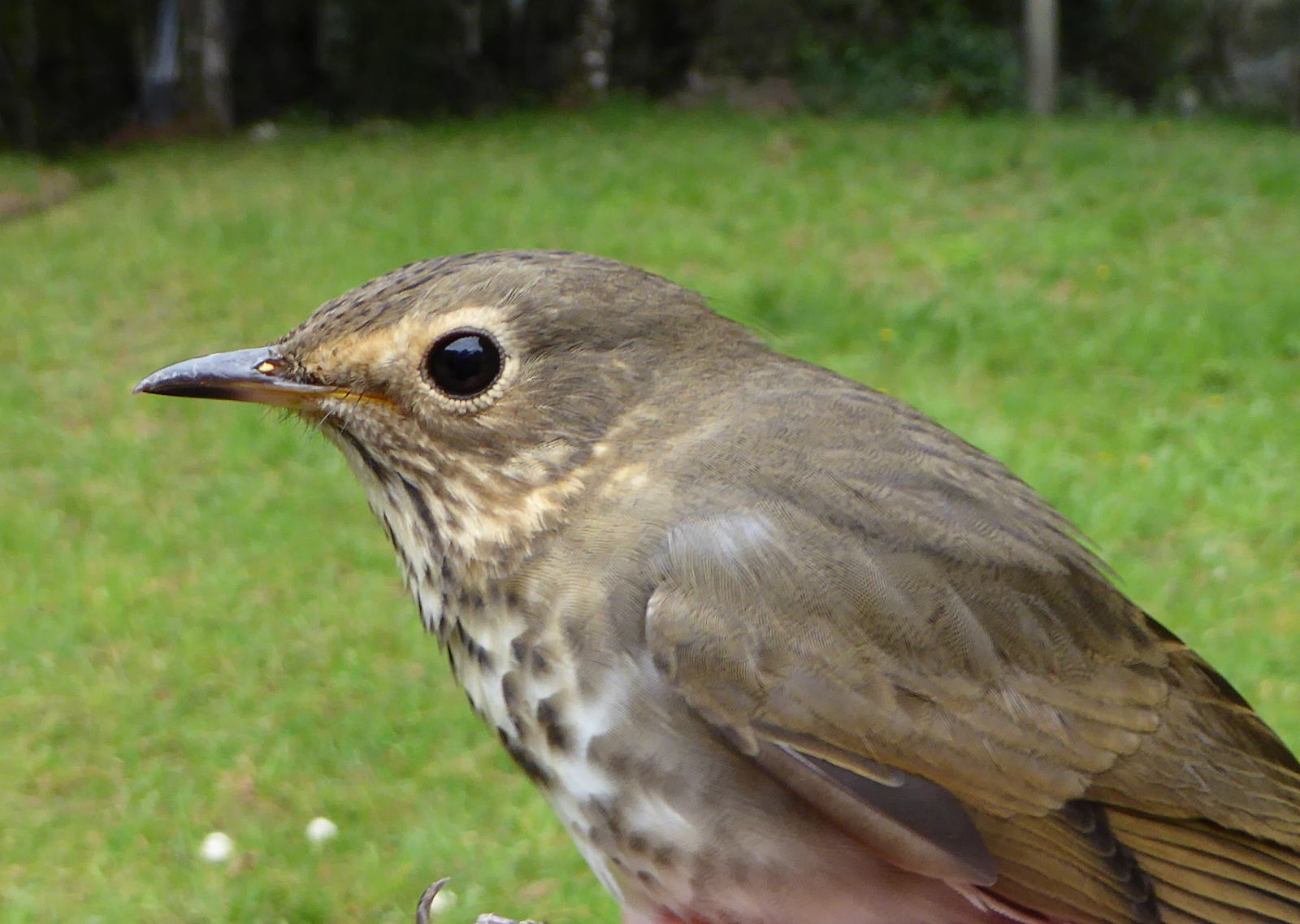
 Finally a couple of our less numerous Lowland Caribbean forest Woodcreepers


A Plain Brown Woodcreeper at our Parque Nacional site, our first since 2012


This Northern-Barred Woodcreeper, the second largest Woodcreeper in Costa Rica.

We have nearly finished our two month spell with Costa Rica Bird Observatories having renewed old friendships and gained new friends and contacts in the Pan American birding scene. We have seen an amazing variety of species as on our previous visits. Our thanks as ever to Pablo Elizondo and CRBO, also to San Vito Bird Club for their hospitality and banding experience.

Richard and Wendy

Monday, 23 October 2017

Serenaded by Fruitcrows

A quite un-believable start to our standard banding session at our Parque Nacional site here in Tortuguero this morning. Very quiet for migrants with only one Swainson's Thrush....but....!!


The first bird we extracted was this male Royal Flycatcher, only the second that we have ever seen on our six visits to Costa Rica.


This fine start was followed by two adult female Black-crowned Antshrikes...both of which were recaptures. One female was banded before 2012 and the other likely banded in 2014, nice ageing data !


All the Hummingbirds that we caught this morning were Long-billed Hermits except this Band-tailed Barbthroat.


Wendy working on the forest floor towards the end of the session in 30°c of humid forest heat and with many interesting biting insects.


Today was a very good session with no rain interruptions and by the end of the morning we had also captured three migrant species, an American Pygmy Kingfisher and a White-collared Manakin.

In total today's effort resulted in five new birds, three recaptures and five Hummingbirds.
Our banding in Costa Rica is usually filled with exciting species, but not numbers. I am emphasising this in response to questions received. The diversity is immense but the numbers captured are quite likely well below what you would think.
Whilst banding we were serenaded by Purple-throated Fruitcrows directly above one of the nets. Two Chestnut-backed Antbirds sang all session. Great Green Macaws flew overhead and higher still Black and Turkey Vultures, with Magnificent Frigatebirds gliding around.


Yesterday we were affected by rain, but we did catch some migrants with five species of Flycatcher - including five Great Crested Flycatchers !

We also captured a couple of  Red-eyed Vireos.


Bi-coloured and Chestnut-backed Antirds were the highlights at our Cano Palma site on Friday....


Surprisingly both these Antbirds were new rather than recaptures.


At Cano we also captured three species of migrant Thrush, including our first Wood Thrush of the Fall.
Two species of Hummingbird, including an unusual one for us, a female Crowned Woodnymph and this fine adult male Red-capped Manakin.


We don't very often catch raptors, so our second ever Semiplumbeous Hawk was a welcome chance to study raptor ageing, this apparently an immature.


In summary 16 captures of  9 amazing species at Cano Palma.


Tomorrow morning we catch our boat to the standard banding site Aero. This site is maturing secondary forest and understorey. Slowly some forest species are moving in eg, Black-crowned Antshrike, but tomorrow there should be some interesting numbers of migrant Flycatchers....
The picture shows Wendy banding at the Aero site in September 2013, a year when early morning falls of Catharus Thrushes were regular.

Richard and Wendy

Tuesday, 17 October 2017

In isolation, ringing above the storms....

We have returned today from the Highlands in Costa Rica, a 4wd journey via back roads to bypass the sometimes now non existent Pan-Am Highway. We managed 8 days of standard ringing since the storms, though isolated until today.
We are still finding new features in the avifauna of our Madre Selva site after many visits over the last 6 years. This fine adult male Spotted Wood-Quail, not a species we readily catch though common in the dense low cover of the Highland forest floor.


Spangle-cheeked Tanager, again a high elevation speciality infrequently caught but a core species of the roaming mixed species flocks. Often a couple of Golden-browed Chlorophonias are with the Spangle-cheeks, the Chlorophonias a species we have never been able to study.....yet


Sooty-capped Chlorospingus - often the leaders of the mixed flocks and a good vocalist to guide us.


Flame-throated Warblers are our second commonest resident warbler in the Highlands.


Antagonist of the smaller Hummingbirds, the Slaty Flowerpiercer.
This adult male - slightly leucistic and more importantly a bird we first ringed in 2014 and we have recaptured once a year on our Fall visit in each of the last 4 years.


The Highlands are full of Hummingbirds, maybe the commonest family of birds represented here ?
Here the delicate processsing of a stunning Fiery-throated Hummingbird.


The equally brilliant and iridescent Green Violetear, recently re-classified and another endemic to the Highlands of Costa Rica and Panama.


Chestnut-capped Brush-Finch, the most common species of Brush-Finch we capture. We caught a female with a brood-patch score 4, and a female Large-footed Finch too with bp4. Both species should have finished breeding months ago.


A couple of our most common migrants to finish this visit.
Swainson's Thrush, extremely common in the Lowlands and we find lesser numbers at the high altitude. We were delighted whilst birding early this morning before leaving to see 16 feeding in small groups and moving through. A migrant Olive-sided Flycatcher was a new species for us in the Highlands this morning too.


Behind Wilson's Warbler, Black-throated Warbler is the most abundant migrant warbler, this looking like a 1st winter male but what of the next bird.....


Clearly more Black-throated Green Warbler than Townsend's Warbler, but is it showing hybrid features, the black in the crown looks....??  We see and photo adult male Townsend's Warblers at our Highland sites each year.


A nice glossy capped male Wilson's Warbler...


At our Home banding station (as 6 years ago) a very powerful external security light came into use after the storms and the moths attracted added to the Highland experience !


This rather tatty Silkworm moth perhaps the largest of several large species attracted.

Finally a picture to help explain our isolation above the storm.....
A total of 78 landslides in the two directions - on the Pan American Highway not all quite as bad as this one.


Tomorrow we are off to a dry Tortuguero in the Caribbean......

Richard and Wendy

Monday, 2 October 2017

San Vito, a few more highlights.....

Following on from the last blog from San Vito, just a few more interesting species that we ringed before heading back to the Highlands....


This is a fine adult male Slaty Antwren, we captured a juvenile too. This is a species not often caught but hopefully numbers will increase as the secondary growth matures developing the understorey which the species favours.


Sulphur-rumped Flycatcher:- What bristles .....!!
The previous blog posted below discussed the identification of Black-tailed Flycatcher and Sulpur-rumped Flycatcher. Again biometrics were important in the identification, and the photo just about shows the small dark area directly below the eye.


Kentucky Warblers feature in our posts from Costa Rica over the years, this bird particularly exciting as a recapture returning to spend the winter here.

LOOK....at my spadebill.....!!


 A close up of a tiny Flycatcher - the White-throated Spadebill


This is the Spadebill found in the San Vito area, one of three species of Spadebill in Costa Rica and one of the 70+ species of Flycatcher found in Costa Rica.

We must finish with a thanks to the San Vito Bird Club, particularly Alison and Greg for hosting and helping our visit become a banding success, and to our assistants Alamo and Wilburth.

We captured 223 birds in 6 visits to the 3 standard sites. Each site has been studied since 2004, and shows population change as the habitat regenerates from redundant coffee plantation. Many thanks to the owners of the sites, Alison, Gail, Lydia and their staff too.

Rich D and Wendy J