Thursday, 26 July 2018

July activities - Nightjars to Stormies

Various exciting ringing from members this month both with our Group and as guests of other ringers and Groups. 
A few members have contributed words and pictures here of their experiences.... ..... from CES visits to Nightjars, Stormies and Swallows.
Our first Group visit of the year to Mwnt to catch Storm Petrels was successful 


 and provided a new experience for several of our trainees. 


Angela gave us her thoughts about the night and her first experiences as a potential trainee " "As a newcomer to the world of bird ringing, I thought my experience with the Teifi Ringing Group couldn’t get much better after being asked to remove a somewhat larger bird than I had been used to. With some trepidation, I removed the bird from the bag and was delighted to see the beautiful electric blue plumage of a kingfisher. To hold a bird only usually glimpsed as an azure flash streaking past was very special. However, on a moonless night on the edge of a cliff, we waited for another bird I had only read about and thought unlikely I would ever see - the storm petrel. The lure brought in 4 in total and I was surprised to discover they are much smaller than I had expected and have a smell of lanolin! The one I released sat on the edge of a precipice until it flew off into the night and out to sea. A magical moment." 

That night at Mwnt 14th July 2018 we also caught a Storm Petrel that had been ringed on Bardsey on 26th July 2016. 


Another nocturnal activity that our members have been taking part in is ringing Nightjars. 
This note is from Andrew 
 "My highlight this month was naturally the invitation to appreciate & experience Nightjar. I originally encountered them as a species while in Gibraltar last year, and my excitement was in then realising that through migration they can equally be seen in Brechfa which is quite close to where I live. Seeing any species locally is naturally far more rewarding, and also provided a nice surprise in being able to follow & be shown these chicks." 


 Spot the well-camouflaged Nightjar! (photo Andrew) 

Charlie has also been successful in catching a Nightjar at his ringing site, Fygyn Common. "On my 5th attempt I eventually caught and processed a Nightjar as an adult male at Fygyn Common. Prior to this I have had a net erected and on other occasions I just had the sound playing and on all occasions I did not hear any churring of Nightjar and never spotted one flying around either. I consider this Nightjar may be a lucky catch because I was not aware of any indicators suggesting there was one flying around. What I am sure about is they come out of the Brecfa forest and fly around Fygyn Common catching moths. The evening I caught the Nightjar there were plenty of moths flying around and several caught in the net, so I was not too surprised to have caught it. 


 "Nightjar are such stunning well camouflaged birds. Around their mouths they have what are called rictal bristles as can be seen in the head picture of the bird. It is believed these prominent bristles are used to help them direct moths into the gape of their very large mouths."

 (Photos - Charlie) 

The CES season continues with all sessions so far successfully completed. Although variety and numbers are down there have been some new species for Alison.... 
 "The July highlight for me has been the opportunity to ring a Storm Petrel, but I have also been fortunate to ring another 5 new (for me) species as well" The new species included Treecreeper, Redstart, Lesser Whitethroat and Sand Martin. All species that we only catch in small numbers.

 Charlie was the guest of his old ringing group to ring Goshawks in the nest... "Occasionally members of the Teifi Ringing Group get invited to help other ringing groups with their projects. I was invited to help with such a project to ring Goshawk pulli in England at the beginning of the month. Three pulli were lowered from the nest all were in a healthy condition and quite large. BTO and Darvic rings were fitted, wing length, weight, beak to back of the head, beak to cere and tarsus measurements were all taken. Birds were then safely returned to the nest." 

Swallows are starting to gather in large numbers in the evening over the reed bed on the Teifi Marsh. A couple of sessions of roost ringing have been successful with some Sand Martins ringed as well. Mallard Pond is always a pleasant place to be at dusk and we have had the opportunity to talk about ringing and show some birds to interested visitors. 


Early mornings see us back there to start our long running migration monitoring. Sedge and Reed Warblers have started to arrive on their return migration. Also we are catching good numbers of juvenile Reed Buntings to colour ring for our BTO project looking at adult survival (RAS)

Friday, 29 June 2018

CES 6 -- where are the migrants?

We completed CES 6 today with an extra early start to beat the heat. A total of 50 birds, 34 new and 16 recaptures.
We would have expected more migrant species like Garden Warblers, Whitethroats and Willow Warblers but only 10 of the 34 new were migrants. Rather nice though were two Redstarts, both males in wing and tail moult. Only 6 adult Redstarts have been ringed at CES on the Teifi Marsh since 2009.


Juveniles of some resident species seem to be around in good numbers particularly Robins and Dunnocks but few Blackbirds.
Other less common juveniles today included a Great Spotted Woodpecker, Treecreeper and a Kingfisher. 13 juvenile Kingfishers were ringed on the reserve last year so it will be interesting to compare this years total.
We are still not hearing or catching any Cetti's Warblers since the Spring cold spell. It does look like they have moved away from the reserve or perished. At least 6 territories last year around the Marsh last year.
A few more insects are around the reserve this week with several Scarlet Tiger moths on the reed bed edge plants.


Black-tailed Skimmers around the edges of Mallard pond too, a fairly recent coloniser to the Teifi area.

We look forward to the next CES in the hope that a late breeding season for some birds may produce our missing juveniles.

Monday, 25 June 2018

Sedge Warbler to Ireland

An exciting recovery of one of the 350 Sedge Warblers ringed on migration through the Teifi Marsh this spring.


AED8024 was ringed by us at Mallard Pond on the 13th May after the days of peak migration were over. It was caught in Ireland on the 9th June, a breeding female with a brood patch.
Pollardstown Fen  is a CES site for Irish Midlands Ringing Group, looking very similar habitat to the Teifi Marsh. This recovery adds weight to our thoughts that the Teifi Marsh is a stopover site before the migration hop over the Irish Sea to breeding sites in Ireland.
We do have a small breeding population of Sedge Warblers on the reserve and this evening we caught the first juvenile.


Also we caught an adult female Sedge Warbler with a brood patch 4 that was ringed in France at Treogat, Finistère in August 2015. We had previously caught it in May 2017 which is how we know the ringing details already.

Yesterday the wind finally eased for us to complete CES 5 on the last day of the cycle.
We caught 60 birds, mostly juveniles of resident species including Treecreeper, Bullfinch, lots of Robins, Wrens and Dunnocks. Compared with the previous 7 years this was the lowest. Starting with the bumper year of 2011 the totals were  130, 73, 100, 71, 91, 79 and 80. The most unusual bird was a House Sparrow, the first for our CES. We also caught the first juvenile Reed Warbler of the year.


Our Linnet RAS project is continuing at Mwnt with the first juvenile Linnets now fledged. At the last visit we caught some additional species with 2 Magpies and a Stonechat in the Whoosh Net between Linnet catches and another Stonechat and a pair of Wheatear in Spring Traps.

(photo Andrew Hughes)
Also at Mwnt we catch Storm Petrels but unfortunately the best phase of the moon for dark nights was persistently windy. A brief lull in the wind one evening saw us rapidly plan a visit and we ringed two.


Once the full moon passes we will be trying again, hoping to add more controls and recoveries to our map.

Tuesday, 19 June 2018

Cuckoo calling, another challenge.

This blog is a summary of my first attempt to catch a Cuckoo on Fygyn Common.

It's that time of the year when Cuckoo's start their journey south to the Congo. They only spend about 2 months in the UK and the remainder of the year in Africa.
The Cuckoo population has halved in the last 25yrs and the conservation status is currently red.
The BTO have embarked on "The Cuckoo Project" to understand the full annual cycle of the Cuckoo that would help them make informed decisions. There are some studies that have beed done in the UK breeding season but little is known of what happens when they migrate back to the Congo. Below is a link to the project that is a very interesting read.

https://www.bto.org/science/migration/tracking-studies/cuckoo-tracking/about

Annually every spring I have Cuckoo's on my Fygyn Common site in Carmarthenshire on the southern edge of the Brecfa Forest. This year I got my permissions in place to use sound with the fantastic support and trust from the BTO, albeit I was a little late sorting it all out.

I also got advice from the BTO website on the best way to catch them, supported by a video.

https://www.bto.org/science/migration/tracking-studies/cuckoo-tracking/about/how-catch-cuckoo

https://www.youtube.com/watch?v=HXosfMkUoTA&feature=youtu.be

My first trip was planned for the 18th May, however it was a little late in the season.


In preparation for this I sorted a couple of potential places to erect a net. On Fygyn Common there are a few areas where the trees are too high but other areas have small bushes and trees that are more suitable. Cuckoo's will respond to sound and perch on top of the tree near the sound, so lower the better. When they hear the bubbling sound of a female they swoop down and hopefully into the net.


On the day the net was up at 06.30am and a Cuckoo decoy was positioned by the sound system which was placed in the middle of the net. Cuckoo could be heard calling some distance away.


As soon as it was switched on a Cuckoo was seen flying straight towards the tree attracted by the sound to investigate. I was retreating quickly to hide behind some Gorse bushes so as not to frighten it off. As soon as the female bubbling sound came on the Cuckoo became very excited and swooped down flying into the net. it was all over in less than 5mins.

The male bird was ringed and processed and whilst I had it in my hand 3 other males flying together past over me and I also heard a female bubbling. So I feel confident there are at least 5 Cuckoo's hanging around the Common.


Time for a net move deeper into the Common and this time there was a lot of interest in the sound, even when the female bubbling sound came on. However they just would not come into the net. I have concluded from this they were probably familiar with the sound which made them cautious but I hadn't got a different sound to try.

Subsequent visiting days later I was experiencing the same thing, birds come to the sound but not flying into the net.

And I thought it was going to be easy after catching the first Cuckoo within 5 mins. I have plenty of time to ponder, wonder and prepare myself for spring 2019.
Wouldn't it be exciting if the BTO were interested in putting a Satellite Tracker on a Fygyn Common bird next year.


Tuesday, 15 May 2018

Wood Warbler, Mallard and CES 2

Interesting news from the BTO this week that a Wood Warbler we ringed in Ffynone Wood in May 2016 was retrapped this May in a wood near Maenchlochog 19 km away. Read about this in Paddy's post on the Pembrokeshire Bird Blog
Spotted Flycatcher and Wood Warbler


We have been continuing our Spring reed bed migration ringing for a couple of hours every morning that weather allows. Sedge Warbler numbers have been reducing after the big days 2 weeks ago. Since the first Sedge Warbler on the 8th April we have ringed 356 on the Teifi Marsh, retrapped 9 from previous years plus the controls detailed in the last blog.
As mentioned in the blog of the 6th May we have the impression that our number of returning Reed Warblers is much lower this Spring than previous years. We have had a look at some historic data to see if there is a rough trend to support our thoughts.
The graph shows a year on year comparison of new Reed Warblers (blue) and returning ringed birds from previous years (red) with similar effort to the 15th May each year.


It is easy to remember the bumper years like 2016 and forget the normal baseline. Hopefully there are still more to arrive back. As we do a Reed Warbler RAS (Retrapping adults for survival) this data makes a contribution to national trend analysis by the BTO. See RAS results for more information.

Last Saturday was an unusual morning with some species not usually caught in the reed bed. A Blackcap and this Whitethroat


 and a 4 year old Great Spotted Woodpecker


Mallard hide is an excellent base for our ringing as we can chat to early visitors to the reserve about ringing and show them birds in the hand.  Not many birds for a group of interested youngsters..


but some Sedge Warblers , a returning Reed Warbler and a 7 year old Reed Bunting provided good discussion points.
With just one Sedge Warbler ringed this morning we will be leaving the Mallard area of the reserve this week. We will return to weekly visits until Autumn migration starts at the end of July.

The first juvenile Siskins were ringed in Richard's garden on 12th May.  10 juveniles ringed which will go towards future years RAS study population (Retrap adults for Survival) at this location.


Just a few lines about CES 2 . It was a cold, delayed start as the nets were frozen. Mist was hanging over the adjacent River Teifi


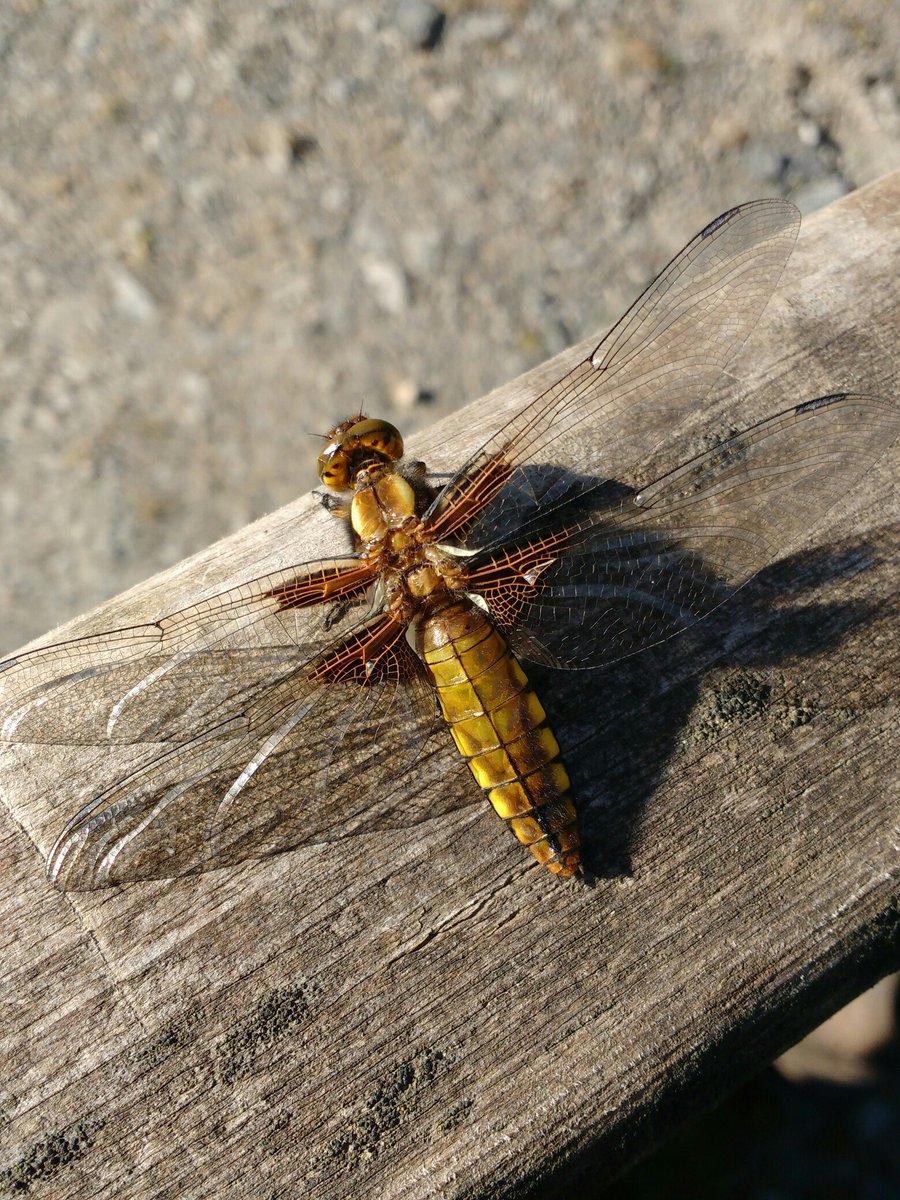
It was a quiet morning for the 5 enthusiastic trainees. Only 31 birds with no juveniles of any species unlike last year when we had many. We made the most of the time though with some useful learning points for all. By mid morning it was very hot and sunny and some emergent insects added interest like this Broad-bodied Chaser.


At other group sites, Karen has been ringing at Goodwick Moor and caught the first Grasshopper Warbler of the year. She has also been ringing Dipper pulli in the Gwaun Valley with a trainee. Charlie is continuing his Tree Sparrow nest box project in the Towy Vally with help from Andrew.
Two of us are off to Skokholm on Monday to assist with general ringing and to colour ring adult Great Black-backed Gulls and Oystercatchers.


Wednesday, 9 May 2018

May Sedge Warbler controls

In the last blog we mentioned that we had caught 4 UK Sedge Warbler controls.
The details were entered into DemOn immediately after the ringing sessions, the new online data entry programme and already we have the ringing details of all of them.

All were ringed as juveniles on autumn migration and now passing through the Teifi Marsh on spring migration.

D994644 was ringed at Squires Down, Dorset  12th August 2016

D879410 was ringed at Orfordness, Suffolk 15th August 2017

S692175 was ringed at Titchfield Haven National Nature Reserve in Hampshire  5th August 2017
It looks like this was a big migration day for them - from Twitter @Trevor_Codlin  "Just shy of 340 birds ringed this AM  mainly sedge (1 Belgium control) & Reed (2 controls UK & France)70 willows 11 groppers"

S816284 was ringed at Keyhaven Marshes, Hampshire 28th August 2017

Since the big days of Sedge Warbler migration last week, the numbers have slowed down with just 20 Sedge Warblers ringed on the last 3 mornings.
Returning Reed Warblers are still slow to return. One from 2016, also seen last spring, was retrapped this morning.

Sunday, 6 May 2018

Sedge Warblers and CES on the Teifi

On May 3rd the Sedge Warblers arrived en masse though we ringed our first bird on April 8th.


We ringed 113 new Sedge Warblers at the Mallard Pond site on the 3rd and on the 4th another 65 at Mallard plus 63 at the CES site as part of CES visit 1. On the 5th we only ringed 30, a lower catch and I expect a couple of larger catches again before next weekend depending on migration conditions. This week we have also controlled 4 UK ringed and 2 French ringed Sedge Warblers.

Though our yearly effort is biased by our trips for overseas ringing, back in 2009 we caught 144 Sedge Warblers on the 4th May - including 3 French controls and we caught 118 - including 2 foreign controls on May 10th ....large numbers are not without precedent for the Teifi Marshes
Maybe more to arrive....!!

An adult Sedge Warbler caught on the 4th May.


We haven't seen such a worn Sedge Warbler and presumably the bird only moulted a few feathers during the winter or survived very tough conditions.....

Only 2 foreign controls is surprisingly low this May, in the 1st week of May 2016 we controlled 9 French ringed Sedge Warblers...!! These figures may be biased by the effort to monitor Aquatic Warblers down the west coast of France, sites the 2 species share on migration in late summer.


The Reed Warbler above was ringed by us in 2014 and recaptured on 5th May - good for our RAS project. Reed Warblers arrive later and in lower numbers than the Sedge Warblers, but this year their arrival appears even later and with lower numbers so far with only 2 retraps and 2 new birds.
In May 2016 the first 10 Reed Warblers caught were all recaptures of our own birds. Presumably most are site faithful breeders though I suspect some are site faithful stop over migrants as we only catch some birds during passage.

Dave Leech has just commented that at Cranwich in Norfolk the first wave of the population arrived two weeks ago with another small arrival yesterday but nowhere near numbers at start of May 2017. By comparison we have caught 4 to date. In 2016 and 2017 our totals were 24 and 15 respectively by 10th May, hopefully many more to come...

We carried out Teifi Marsh CES 1 visit on Friday May 4th.


Apart from the 63 Sedge Warblers, we had a good mix of species including Whitethroat and Garden Warbler. Also some interesting recaptures...
Nice to catch a retrap Great Spotted Woodpecker as we have only ringed 8 during CES sessions since 2010. It was ringed as a juvenile last August. They are often heard on other parts of the reserve but our CES site does not have much woodland.

One of the 4 retrap Bullfinches was ringed by Chris in his St Dogmaels's garden in February, 3 Km away from the CES site. We also ringed 8 new Bullfinches, a species that seems to be increasing on the reserve.


A Blue Tit ringed as a juvenile in 2012 was the oldest retrap. It has been seen each year since apart from 2017.
Goldcrests were another species not often caught at CES, just 24 in 8 years so 3 retraps in one session including one with a brood patch was unusual.
Altogether we processed 91 new birds and 45 retraps, lots of learning points for two of our trainees.

A visit to our Mallard Pond site in mist this morning, the 6th produced little, just 4 new Sedge Warblers !!
Meanwhile Karen was ringing on Goodwick Moor where only 6 Sedge and 1 Reed Warbler were captured.
We will see what tomorrow brings, and a small ringing demonstration at the Mallard site too.