Sunday, 29 August 2021

Late Summer - some results and thoughts.

Some notes from our activities over the last few weeks...

Reed Warblers

The number of Reed Warblers re-encountered for the 8th year of our RAS project is looking as expected with 42 birds from previous years.

We seem to be finding more females with brood patch 5 and in body moult ?  Have we no late nesting attempts ? Certainly many juveniles of several species including Reed Warblers have been caught with poor feather growth this season. Many examples of tail and wing feathers with fault bars. The example below is a Great Tit with a marked fault bar.


Sedge Warblers

Sedge Warbler ATP3573

Ringed Icklesham, Sussex 13/08/2021 by Rye Bay Ringing Group
Re -encountered Teifi Marshes, Ceredigion 19/08/2021 6 days 389 km West 

The movement above adds interest to the origins of our Sedge Warblers. We have thoughts that the reason we rarely find a control from further north is that a large proportion of our Sedge Warblers are passage birds from breeding areas of Ireland where few birds are ringed. The bird above maybe an arrival in the south east now heading west - or just a wandering juvenile...

Swallows

Much lower numbers seen than previous years. Maybe the Swallows are using Maize fields down towards the estuary to feed over and roost. The largest roosts seen so far this season is only c250 birds and very few Sand Martins seen.

A breeding male with a nest in a garage 3kms away was caught in the roost, subsequently seen again at the nest 2 days later and now has another brood. We have not recorded this behaviour before and we assume the adult was on a feeding visit to the reedbed.

Reed Buntings

The number of Reed Buntings re-encountered for the 11th year of our RAS project is looking above average with 42 birds from previous years. Many of these are re-sightings of colour ringed birds with the majority of these sightings from our feeder near our Mallard Pond trapping area or from random feeding by Reserve visitors regularly leaving wild bird food in the car park.

Garden CES

The 2nd season has now been completed. 364 encounters of 20 species, 510 last year also 20 species with same nets and session length. The gut feeling was a decline in juveniles and this is backed up by the data and the graph clearly shows the smaller number of juveniles of selected species.

It will be interesting to see the BTO analysis of this season across all of the garden CES sites.

Storm Petrels

Only 3 Storm Petrels were ringed by the Group in 2020 but one of those has been re-encountered this month in Anglesey.

Storm Petrel 2720334

Ringed Mwnt, Ceredigion 17/07/2020

Re-encountered Point Lynas, Amlwch, Anglesey 03/08/2021 382 days 145km N


Into the autumn at our old CES site by the river and  Pentood Marsh nets. A mixture of reed bed, scrub with a lot of bramble that is fruiting well. Over the coming weeks these sites will become our focus as the numbers of acros fall, Chifchaff and Blackcaps will make up the bulk of the captures with a few species of an autumnal flavour...

Rich D & Wendy J

Sunday, 1 August 2021

Juvenile Acrocephalus Numbers

The following table summarises the number of juvenile Acrocephalus warblers ringed on the Teifi Marshes up to the end of July for each of the last eight years.

RW = Reed Warbler
SW = Sedge Warbler
effort = ringing sessions, i.e. a combination of the number of days and different sites at which ringing took place.
RW/e and SW/e indicate the number of new juvenile birds ringed per session, rounded to the nearest whole bird!


RW SW effort RW/e SW/e
2014 131 98 26 5 4
2015 89 53 17 5 3
2016 82 67 22 4 3
2017 84 120 21 4 6
2018 99 132 28 4 5
2019 30 46 18 2 3
2020 57 64 20 3 3
2021 48 58 14 3 4


The numbers will be a function of both the number of breeding pairs present and of their breeding success.

Monday, 26 July 2021

Mid summer - Seabirds and Warblers

Over the last few weeks the Group has been busy with many varied activities. 

On the Reserve..a juvenile Cetti's Warbler was the first likely to have bred on the Teifi Marshes Reserve since 2017. This follows the wipe-out of our previously successful breeding population by the "Beast from the East" in early 2018

Sedge Warbler Z053132 trapped Teifi Marshes on the 1st July in the same net as ringed ... but at 6 yrs 11m 8 days later, appears to break Welsh record by about 3 weeks

Old birds at garden CES too, a  Chaffinch ringed in July 2014 and not seen until this month.

Storm Petrels

We have made two visits to Mwnt this year to ring Storm Petrels. Small numbers ringed on each visit but already one of them has been caught elsewhere. 

Storm Petrel at Mwnt (Photo Toni)

2720337 was ringed at Mwnt on 13th June this year and caught by ringers on Little Saltee, Wexford on 23rd July 40 days, 132 km West

Mwnt to Little Saltee

Skokholm

Four of the Group and two trainees from Gower Ringing Group enjoyed a weekend on Skokholm at the beginning of the month. 

South coast path - Andrew

As expected in early July it was quiet for Passerines but the group were able to spend time learning some new techniques and species.

A team effort to top up the colour ringed population of Puffins in Crab Bay was an excellent learning experience. 

Colour ringing Puffins in Crab Bay.

More photos and details about this project on the Skokholm blog 

The gull trap was used for the first time since 2019. Some food slops were used to entice gulls into the trap. 23 gulls were caught. Four adult Herring Gulls were colour ringed as part of a long-term study into adult survival. Again, more on the Skokholm blog 

Alison ringing a gull

Other activities included ringing Manx Shearwaters for a few hours each night along the study transect, ringing Oystercatcher chicks and running the Heligoland traps. 
Thanks to Rich, Giselle and the staff on Skokholm.

Details of some recent Controls


Reed Warbler AZL7341

Ringed Keyhaven Marshes, Hants 27/08/2020

Re-encountered Teifi Marshes, Ceredigion 29/06/2021 306 days 262 km NW


Goldfinch
AYR0412 

Ringed Bardsey Island, Gwynedd 29/04/2021

Re-encountered Llechryd garden CES, Ceredigion 12/06/2021 44 days 77km S 

Also at garden CES on 22/07/2021 84 days


Finally, a welcome to our new trainee Thomas Faulkner.

Sunday, 6 June 2021

May news; birds on the move - Russia, Portugal, France, Scotland...

The end of April into the beginning of May saw the expected passage of Sedge Warblers through the Teifi Marshes.

151 ringed this spring and several returning birds. The oldest was ringed in 2017

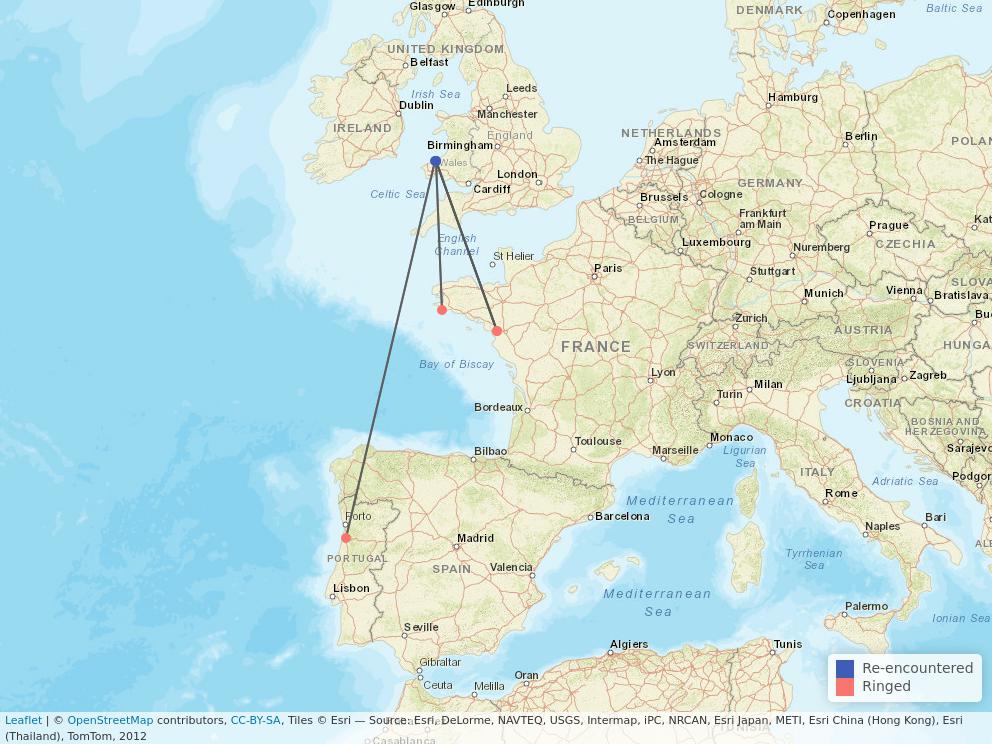
One Sedge Warbler had been ringed in Portugal in 2015 on its first migration south, the Group's first recovery with a Lisbon ring.


Sedge Warbler A396383

Ringed  Salreu, Aveiro, Portugal 02/10/2015

Re-encountered Teifi Marshes, Ceredigion 07/05/2021 2044 days 1298 km NNE

and two others had been ringed in France

Sedge Warbler 8574578

Ringed Trunvel, Treogat, France 08/08/2020

Re-encountered Teifi Marshes, Ceredigion 01/05/2020 266 days 468 km N

Sedge Warbler 8933871

Ringed Frossay, Loire Atlantique, France

Re-encountered Teifi Marshes, Ceredigion 29/04/2020    261 days 572 km NNW


Several of the group are still catching Siskins in our gardens, a mix of local breeders and those on their way back to breeding areas illustrated by the following movements...


Siskin ARP8598

Ringed Boncath, Pembrokeshire 20/03/2021

Re-encountered Ballater, Aberdeenshire  15/05/2021 56 days 569km N Grampian Ringing Group

Siskin  AZN2321

Ringed Crynant, Neath 22/05/2021

Re-encountered Clarbeston Road, Pembs 29/05/2021 7 days 79km W Gower Ringing Group

Siskin  AEK0683
Ringed Clarbeston Road, Pembs 17/05/2021

Re-encountered Peebles, Scottish Borders  27/05/2021  10 days 437km NNE Borders Ringing Group

Some details of controls and recoveries of other species received this month...

Woodcock EZ52435

Ringed near Ffarmers, Carmarthenshire 16/01/2020

Shot Vokhtoma, Kostroma O, Russian Federation 06/05/2021 476 days 3080 km ENE


Dipper RZ13870

Ringed Llandilo, Pembs 28/04/2020

Re-encountered Dolbont, Pembs 06/04/2021    343 days 12 km N

Interesting movement across the Preseli Hills


You might have noticed that the maps in this blog look different to our usual Google Earth images. Many thanks to Stephen Vickers for creating the new, easy to use mapping tool.


The garden CES in Llechryd is continuing this year. As ringing has been carried out there since 2008 a lot of old birds are turning up. This Dunnock was ringed in 2013 and not seen since. Although not a UK longevity record it looks like it might be the most number of years since ringing of a Dunnock in Wales.


Not many juveniles have been ringed yet, just a Robin and Dunnocks. Blue Tits are already being seen in post-breeding moult.

If you missed Andy's interesting post about progress with his House Sparrow RAS it is worth a read

House Sparrow April summary


The main activity of several group members in May and June is nest box monitoring. Details of results to follow in a blog post once the breeding season has finished. 

One of Andrew's nest boxes in Ffos Las

Initial comments have been that several boxes failed with high mortality prior to fledging in the stormy weather. 

Sunday, 2 May 2021

House Sparrow RAS - April summary

April was a busy month with 57 colour ringed birds re-sighted and a further ten processed (4 new, 6 subsequent encounters). ‘Brown bib’ as I started to call him, is now P05 and poor old ‘Stumpy’ is still ‘Stumpy’ as he does not have the means to retain a colour ring on his left leg. N41, an adult female from 2018 or earlier, went missing around the beginning of March but turned up without its’ colour ring and so is now P10.

40 of the colour ringed birds were males (41 with 'Stumpy') and 26 were females.

16 of the re-sighted/ringed birds were known to be full adults and 25 of the birds were from 2020 nests. The remaining 26 were birds that could be from 2020 nests or any time earlier.

Much of the re-sighting work that I have done has been from a ‘comfy’ chair while having a morning cuppa. I have found that it is worth looking at different times of the day to record other individuals. I can pick out quite a few birds because certain feathers are worn, broken or simply white but when they do not even have a metal ring (let alone a colour ring), I can hear myself ‘tut’ out of mild frustration.

Although the April mornings were often chilly, the sunshine during the day was warm and I frequently watched the house sparrows flycatching over the lawn; what they lack in ability, they make up for in perseverance. During one spell at the bottom of the garden, I watched a party of at least 6 birds all flycatching in the adjacent field being grazed by cattle. These birds could be seen returning to their nests to feed chicks and then returning to the field.

I have also been looking at my nest boxes and some other breeding locations that I identified last year. Gradually I am starting to build a picture of how many pairs breed and if I am lucky even at this early stage, I can see which birds are breeding where. It is already becoming apparent that ‘parental responsibilities’ and ‘home ownership’ may not be as straightforward as I had previously considered. Colour ringing of a largely sedentary and social species presents an opportunity for more than just survival rates to be calculated.

Today, the 2nd of May, started chilly and quite still and I managed to colour ring another 9 adult birds (7 new birds and 2 subsequent encounters of birds from 2020). 7 of the birds were females and all had some degree of brood patch; these birds help to address the imbalance of males to females seen in April.

My hopes of seeing some young fledge from my most advanced nest box this week have been dashed. The incumbent male (P01) busily went about his feeding duties then went missing sometime after the morning of the 25th of April and after several sorties from a male Sparrowhawk. The female (N53) was last seen on the 27th. Then, on the 28th, three fresh dead chicks at FS stage were on the ground under the box and a single piece of dry grass was poking from the nest hole. Retreating from the vicinity, a new male and a new female were observed entering the box and perching nearby with the male calling frequently. P01 and N53 have still not shown up.

Thursday, 22 April 2021

April news, Sedge Warbler...from Lough Neagh

Lough Neagh to the Teifi - finally


The Sedge Warbler migration season on the Teifi Marshes has started with the retrap of a bird ringed in Northern Ireland.
ACE5804  ringed as an adult Lough Neagh, Tyrone Northern Ireland 27/07/2019
                 Subsequent encounter    Teifi Marshes, Ceredigion 20/04/2021
         633 days 305 km SSE
This bird would would have covered a lot more distance than 305km having been to Africa at least three times.


Looking at the excellent blog of Causeway Coast Ringing Group
this Sedge Warbler was one of 167 ringed on 27th July 2019. It is always interesting to read about the sites and activities of other groups whose birds we encounter and particularly nice when the ringing session at which the shared bird was ringed is written about.

Return to Lough Neagh 2019

The first Sedge Warbler on the Teifi Marshes caught this spring was a returning bird ringed in 2017.

Early Reed Warbler singing for 3 days from the 1st but one not heard again or caught until the 22nd. A nice start to Reed Warbler RAS, this was a bird originally ringed in July 2018. In most years the first Reed Warblers we catch are returning site faithful adults. 

Once again this spring the Teifi Marshes are an important roost site for migrating White Wagtails. Up to 60 on some nights have been over the reed bed at dusk.

 
As of today we have ringed 46 White Wagtails this April. Often in the evenings on the Marsh we have large numbers of Hirundines feeding, eg on the 20th c500 Sand Martins. These adult birds - unlike birds in the late summer rarely get caught in the nets. In fact wthis year none ...so far.

Following the wipe out of the Marshes Cetti's Warblers in 2019 due to the Beast from the East, and apparently  no on site breeding since, great to have caught 4 new Cetti's this spring and to hear them day and night. Where are the six presumed passage Cetti's we ringed last autumn...?

Reed Bunting RAS.  The colour ringing is proving a great success, even the ad hoc feeding station in the car-park has already helped us to 24 sightings in April. 

Reed Bunting by Tommy Evans

The colour ringing of these birds is an on-going annual ringing and re sighting project now in the 7th year.

The above is a short summary of activities on the Teifi Marshes.

A post to follow with updates from other projects from other sites we study.

(Wendy J and Rich D)

Sunday, 21 March 2021

Early Spring Movements....

The focus has been on garden ringing while travel restrictions were in place. 

Several of the Group have been ringing in gardens for many years so useful long term data is being collected. This Coal Tit with abnormal plumage was ringed in 2015 and has only been re-caught once since. The longevity record is over 9 years so a while to go yet for this one.


Siskins are one of the most frequently caught species in March. Over 200 ringed by the Group so far this month.
 
 
Some Siskins are starting to show signs of breeding while others are still migrating with a lot of fat, the heaviest weighing 16.6g

Many are site faithful both on migration and breeding. 
Richard  caught 2 Siskins, both ringed at the same time in January 2019 and caught together this year, 2 years later. One of them was also caught in April 2019 with a brood patch so breeding locally. Arfon had the same with 2 ringed together last February and caught side by side in the net this month.

Siskins also move between our gardens in Llechryd, Boncath, Ffarmers and Bancyffordd even though up to 46 km apart which was the movement of a female from Boncath to Fframers and back again. Siskins frequently move backwards and forwards between the closer gardens which although 6 km apart are joined by more or less continuous woodland. 

 
A first though was this local Lesser Redpoll movement, ringed in Llechryd in January when several were visiting the garden and caught this morning in Boncath.

 
We are waiting for details of 2 birds ringed elsewhere and caught in Wendy's garden this weekend, a Siskin and Coal Tit. The Coal Tit recovery is of particular interest....

Some recent news of other birds ringed elsewhere

Blue Tit
ARF3088 ringed in Sunnyhill Wood, Tregaron on 31/05/2020 as a pullus by Mid Wales RG
                Re-encountered  Llechryd, Ceredigion 06/03/2021  279 days 51 km WSW 
This was an interesting movement as Blue Tits do not often move far. The route was possibly down the River Teifi.
 - Of interest as we write a Blue Tit has appeared on Skokholm this morning !

Goldfinch
S872982  Ringed Funtley, Hampshire 03/12/2017 by Trevor Codlin
                Re-encountered Llechryd, Ceredigion 08/03/2021 1191 days 271 km WNW 
This too was interesting because the same movement of a Goldfinch had occurred previously. One ringed in Funtley in March 2016 was in Llechryd in April 2016, 29 days later.
 
The map shows some of the Goldfinch movements to and from Llechryd 


A Goldfinch caught today in Llechryd had been ringed at Mwnt in 2018 while whoosh netting Linnets for a RAS project. As always, March has proved to be an important month for recording Finch movement.

Colour ring recording plays a very important part in the BTO ringing scheme. We encourage photographers to help with this. We were grateful to Tommy Evans, one of our local photographers, for managing to get the code on a colour ringed Knot that was in the Teifi Estuary for a few weeks earlier in the year.

 
It had been ringed on the Dyfi Estuary at Ynyslas in September 2020 by Mid Wales RG, 130 days 64km.
Read "We're Knot flagging" on Mid Wales Ringers blog about the project and some of the resightings including one seen in Portugal.

This year sees two new colour ringing projects for the group.
Arfon has just started a Willow Tit RAS in the Tregaron area with the first birds colour ringed this weekend.

 
More on this from Arfon as the year progresses.
Andy's RAS on House Sparrows is showing how useful the numbered rings are in monitoring a species which are very net wary.  Just last week alone he recorded 23 males and 21 females visiting the feeders. 9 of the 44 were originally metal ringed from 2019 or earlier. 
 
Last month we held our AGM by Zoom. The usual agenda business was conducted successfully through this new way of meeting for the Group. After a difficult year, particularly for our trainees, we made the simple target for the year -   To get back to sites as a priority then the plans and ideas will flow for the year.
With Wales "stay at home" restriction now changed to "stay local" last week we can once again start to ring at a few sites beyond our gardens.
 
(Wendy James and Rich D)