Thursday, 26 March 2015

Winter lamping ends with a Fieldfare

A typical scene on most dark and windy nights since last November...
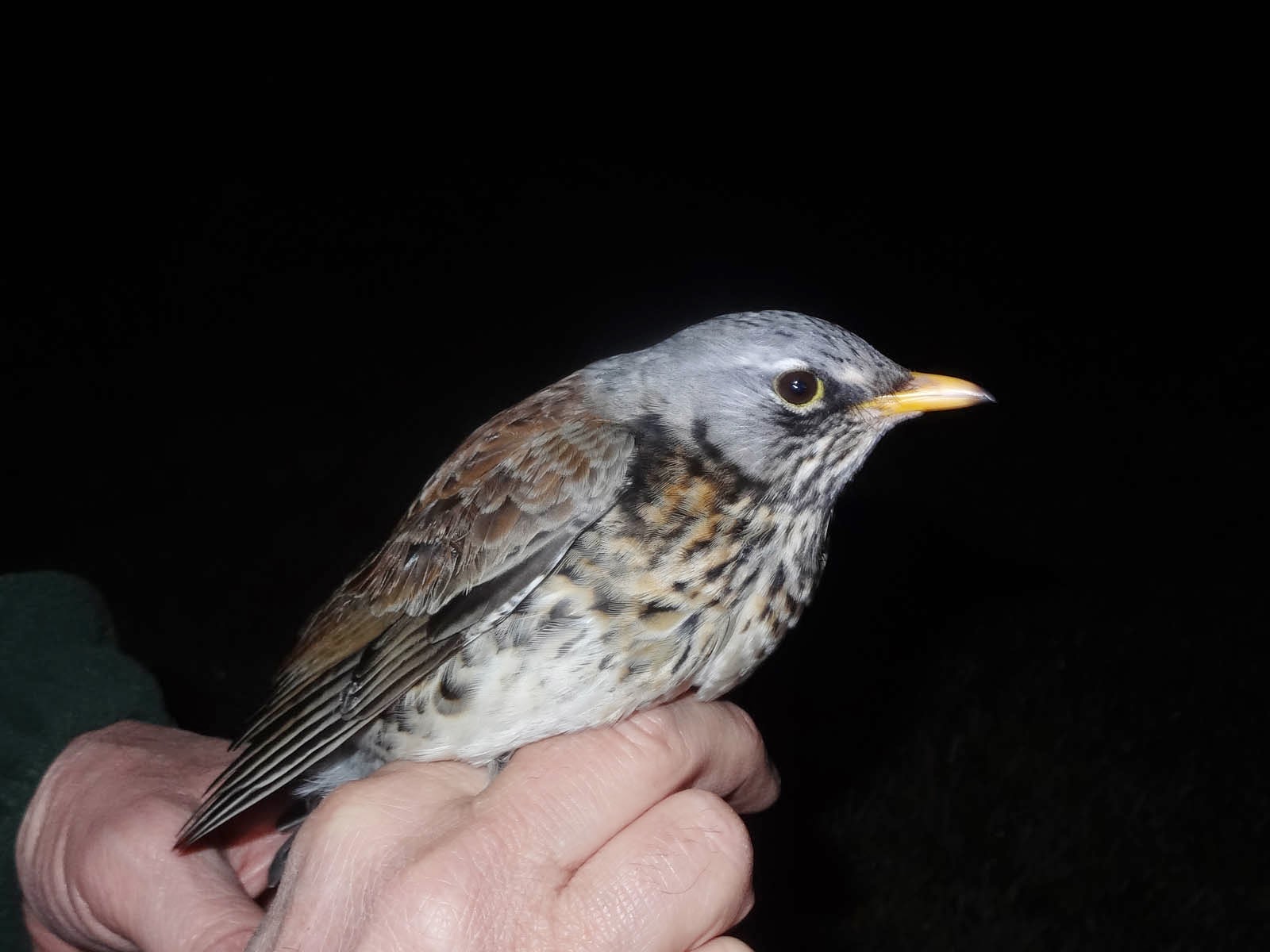
but with the birds that spend winter roosting on our sheep pasture now heading back to their breeding grounds it is getting harder to find birds when out lamping. On our last visit this week we didn't see any Woodcock but did catch a Fieldfare.
Most of the fields we walk have now been heavily spread with slurry and with the moon waxing it is just about time to stop lamping. Although never say never - our latest Woodcock were caught on 5th April so if the weather is right we might be out again.

It has certainly not been an easy year for catching Woodcock. Mid Wales ringers have had good numbers of birds roosting but we have had no big nights of catching, mostly one or two a night despite walking an average 4 km.  Redwing and Skylark have been well down too but more Fieldfare.

Totals of birds caught by lamping this winter...

Woodcock - 44 ringed and 3 retraps


Once again, the most productive site for finding Woodcock has been the improved grassland sheep pasture on Frenni Fawr, our highest highest farm at 274m.
Snipe -6
Golden Plover-11
Fieldfare -20
Meadow Pipits 14 and 1 retrap
 Mistle Thrush 1 - a first for us to catch by lamping
 Redwing 2
Skylark 5
As well as the birds caught we have also been recording all waders seen and field use to add to the value of our long term monitoring of these North Pembrokeshire farms.

Our attention will now be changing to evening roost ringing instead as soon as the White Wagtails start moving north through the Teifi Marsh.

Wednesday, 18 March 2015

First Wheatear..

With news of Wheatear turning up on the Pembrokeshire Islands this week, a look at Mwnt, our coastal ringing site, was a must.
Two were seen on Monday
so that inspired us to dust off the spring traps and head there this morning. It was a very foggy start but the sun broke through to be a clear blue sky day.
The first bird was a surprise - a Meadow Pipit we had ringed there in April 2011, one of three ringed that day.
6 male Wheatear were around the headland and we caught two of them.
Other birds ringed were 2 Stonechat, 2 Meadow Pipit and a Rock Pipit.
Thanks to the National Trust for permission to continue our work at this beautiful location.

Night time lamping is continuing. Woodcock are ready to migrate and always tricky to catch in March but a Skylark and some Meadow Pipits have been ringed this week. A few Fieldfare are still roosting on the fields but Golden Plover haven't been seen for a week.

11pm update!!
There are still some Golden Plover about. We ringed one of two seen tonight on Frenni Fawr
Only one Woodcock seen on a quick look at two of our sites.

Tuesday, 10 March 2015

3 years and 3 months..

Hello again...
With the moon now rising later it is time to head out to the hills again before all of our Woodcock leave. Last night on Frenni Fawr we caught a Woodcock that we ringed on 30th November 2011 and haven't seen since.
Looking back at the blog about that night in 2011 it was the first time we had used our new GPS data logger so the ringing position of EX37999 was recorded accurately. It was only 112 metres from where we ringed it.
Like the majority of our retrap Woodcock it was caught very close to its ringing location despite several long migrations.
It was a quiet night with only 4 Woodcock, 3 Fieldfare and a few Snipe seen. No Golden Plover and no mammals, not even a rabbit!


Saturday, 7 March 2015

Sand Martins first !.......Stormies to follow.....

The first Sand Martins of the year were seen by Wendy and Sue whilst counting for the Teifi WeBS !
As usual, a nice early record for The Teifi Marshes.
After I heard the news, while doing my WeBS count in Fishguard, I returned to pack the Lanny for the season ahead !
Nets on top of lamping gear....
The winter hill season is not over, we will be back out on the hills in a few days. We have caught Woodcock as late as April 5th....

To finish the latest recoveries from the BTO, this nice Storm Petrel movement.


Ringed on Bardsey 26th June 2014.....and with us 5 days later. Another movement which appear to show "our stormies" are faithful to the west coast....

Friday, 27 February 2015

Teifi - Warblers in the Winter sun....

Likely migrant warblers, not our local breeders !
A new Chiffchaff, and a couple more Sedge Warbler recoveries to think about...

A Chiff with Helgoland ring, that we caught in April 2014. We are still waiting to hear when and where this was ringed but news this week of one that we ringed 8th August 2014 that was caught in south west France at Etang-de-Moisan, Messanges, 74 days later on the 21st October.

Where did these Chiffs come from ??
I guess the first part of their migration is like our Sedge Warblers, a movement south-east first to cross the Channel ?


These recoveries show us how our Sedge Warblers progress, we know West Africa is the destination.
The recoveries that we have suggest our birds do leave via the south-east rather than the south-west, interesting as we are so far west ourselves.

The movements of our Reed Warblers is not as obvious.
We have great retrap data on site fidelity and longevity, but we don't hear much about our Reed Warbler stopover on their migration.

Reed Warbler movements
D432363
19/05/2013 Teifi Marsh Ceredigion:
Retrap 19/06/2014 Little Crosthwaite: (Cumbria) 301km NNE 1 yr 31days
D615737
25/08/2013 Teifi Marsh Ceredigion:
Retrap 27/09/2013 Gautegiz-Arteaga, Vizcaya:, Spain, 980km S 33 days
D761845
16/08/2014 Teifi Marsh Ceredigion:
Retrap 14/09/2014 Icklesham: (East Sussex) 390km ESE 29 days
L052113
05/05/2010 Holyland: (Pembrokeshire)
Retrap 02/05/2013 Teifi Marsh Ceredigion 48km NNE 2 yrs 362 days
Y326071  
12/08/2011 Teifi Marsh Ceredigion
Retrap 20/07/2014 Oxwich marsh: (Swansea) 65km SSE 2 yrs 342days
Y560378
30/07/2012 Teifi Marsh Ceredigion) (Ceredigion)
Retrap 11/07/2013 Bude Marshes Nature Reserve (Cornwall) 139km S 346 days


This makes the study of our Teifi marsh so fascinating and valuable.
Our CES and RAS projects provide useful data on our breeding birds, but it is our recoveries and controls that tell us how valuable we are as an important feeding stopover site for migrants.

Tuesday, 24 February 2015

A Woodc....three winters missing....?

Or a site faithful migrant ??

EX37984 was ringed on Frenni Fawr during a blustery night, the 1st November 2011.
Retrapped last night, between gusts of wind again on Y Frenni.
As one of our standard Woodcock monitoring sites we visit the site approx 4-6 times per month during the winter nights...November to March, and usually an April visit to find late migrant thrushes.

Where has EX37984 been ?
Have we missed him on so many visits, I doubt that, or is he purely a passage bird wintering further southwest.......


Back in 2011 we were just starting to GPS the location of all ringed Woodcock, a pity that we haven't the exact location for EX37984......I guess that both captures were in the same field.

Earlier this week, in the same field, we retrapped a bird that we had only ringed 2 weeks ago. The map shows how close the recapture was to the position when first caught....
As EY81436 shows, this is another example of amazing site faithfulness to the field, regardless of Foxes, Badgers etc..

Friday, 13 February 2015

A nightime six of the best....

A great night out with six waders of three species caught under the lamp. Three Woodcock, one Golden Plover and two Common Snipe - a species we don't often catch.


We suspected that we may be catching a greater proportion of adult Woodcock, here is some data from  previous seasons...
The figure is the percentage of juvenile birds, one of which is in the picture below.

 Winter season .....2010/11  82%
                             2011/12  48%
                             2012/13  50%
                             2013/14  51%
                             2014/15  40%...the.current season


Our average winter catch is c50+ birds and we should ring our 300th Woodcock in 6 years near the approaching new moon on the 18th February...!! We are not sure why the proportion of juveniles in 2010/11 was so high.

We are helping Paddy Jenks with counts of waders seen on the pastures at night as well as birds caught. See Paddy's post "Monitoring Woodcock and Snipe"
Species like Woodcock are difficult to survey, and counts at night may prove helpful. The map below shows Woodcock caught this winter at our three main survey sites, if this density is repeated on all suitable fields, then we have a substantial and unrecorded wintering population.


The sign of a successful night.....the wine gum pot is empty ...!!