Tuesday, 14 February 2012

Uganda trip report


Malcolm has finished compiling the full trip report of our 3 weeks of incredible ringing and birding...we did record c450 species as well as ringing 149 species.
See African Affinity Birding for the report...and more !!
Or contact Malcolm Wilson.....shoebill@mweb.co.za

Saturday, 11 February 2012

Bee-eaters,Buzzards and more....

After leaving Budongo forest, we headed north where we set up camp on the banks of the Nile in Murchsion Falls National Park.
With the totally different habitat we were soon catching new species including Sulphur-breasted Bush Shrike,
White-browed Coucal (the smelliest bird I have ever handled)
White morph African Paradise Flycatcher
And particularly exciting, Northern Carmine Bee-eaters.
The days settled into a pattern of early morning mist nets around the camp then heading across the Nile in the precarious looking ferry to target raptors.
As part of ongoing work looking into the effects of burning the grassland, Malc was pleased to catch 8 Grasshopper buzzards which are migrants. They often follow fires where they prey on insects being driven out. It was amazing to watch this first hand as we drove through a burn.
One evening we indulged in some birding and went on a boat down The Nile in search of the rare and elusive Shoebill. Our hour off from ringing was rewarded with superb views of this huge bird.
And the day didn't finish with dusk either - there were Nightjar to be dazzled! With the sound of hippos grunting in the background it was rather different to catching Woodcock in the rain in Wales!This was a Plain Nightjar but Long-tailed were also caught here.
With the waning moon we are back to wandering the hills at home with the lamp despite the excitement of our trip and tonight caught 3 Golden Plover.

The Budongo Forest team

Before heading for the Nile and it's wetlands, the Budongo team !
Geoffrey Muhanguzi, the Budongo Forest Project Director, here seated with one of the trainee ringers, with Malcolm standing.Ringing underway in the forest with local trainees.The Expedition team.. Malc, Nathan, Wendy, Rich D, Dawn, Rich C.
Dyfed taking the photo and most of the expedition photos...a fabulous collection.

Friday, 10 February 2012

Site faithful wintering Reed Warblers

Nathan, our trusty ringing expedition trainee, (he helped me dazzle too!) with one of the 28 Reed Warblers caught. Some in active primary moult, all likely eastern birds with long c67-69mm wing length.
2 retraps in Nile Safari Camp...one first ringed 1 /3/2008 and retrapped 26 /01/2012 by us, quite amazing !!
The 3rd Reed Warbler retrap ringed in a garden in Kampala 18/01/2011, again retrapped by us in the same Kampala garden 15/01/2012.

Wednesday, 8 February 2012

Ringing in The Royal Mile

Colour and variety in the forest! ( Red-bellied Paradise-flycatcher)
For five days we were ringing in Budongo Forest, staying at the long established Sonso Field Station. While the main focus there has been the conservation and study of a habituated group of chimpanzees, activities are now broadening to the wider conservation issues within the Budongo Forest Reserve. Core funding for this is from the Royal Zoological Society of Scotland. Our ringing was part of an ongoing study into the effect of changes in forest management on bird populations. We were involved in teaching students so that regular independent ringing can be established there. The students were enthusiastic and quick to learn.
It was a stunning environment to be ringing in, surrounded by massive trees and first class birding between net rounds.
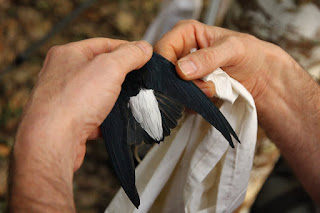
As well as the forest nets, we also had a net over a small river which caught some exciting species. This is where Richard was off to in the last blog - checking the nets by motorbike! The stars were 12 Sabines Spinetails, birds one only ever sees above the forest canopy and hardly ever caught and ringed. Listen to the call which was recorded for probably the first time ever!
5 species of Kingfishers were ringed in the forest including a Chocolate-backed Kingfisher - a species rarely (if ever before??) caught.
Also 3 Shining-blue Kingfishers -
and of the small forest kingfishers, four African Dwarf Kingfishers (10cm)
and several of the slightly larger Pygmy Kingfishers (11cm) -
After calling all day but remaining elusive this Dusky Long-tailed cuckoo finally found it's way in to a net.
And to finish this part of our adventure, a Jameson's Wattle-eye
and a Blue-shouldered Robin-Chat, another bird that is very shy and difficult to observe.
Next, north to The Nile....

Monday, 6 February 2012

From Martial Eagle to the Royal Mile

Impossible to summarise 3 weeks stunning ringing in Uganda with 748 birds trapped of 149 species so raptors to start.....

The only Martial Eagle we caught with a weight of 3.6kg and foot to toe measurement of 154mm was the mightiest bird we have ever handled.
Smaller but no less impressive here is the upper wing of one of three Western Banded Snake Eagles ringed with some fascinating moult scoring. One of the challenges of ringing in Uganda was to moult score every bird we caught as little literature exists on this subject.

From the pleasures of handling eagles and buzzards (3 Long-crested Eagles and 8 Grasshopper Buzzards) to the blooded challenge of falcons and hawks. Each of 4 Grey Kestrels caught inflicted damage!This Red-necked Falcon caused excitement at the mist net at dusk, a species that Malcolm had never ringed before.
A couple of Shikra and African Goshawk completed the raptors caught.

Next on to The Royal Mile, one of the richest birding sites in Uganda where neck-aching canopy and forest floor birding accompanied our 5 days of introducing 6 students to ringing.
More on what Richard was up to here in a couple of evenings as it's too bright to go dazzling for Woodcock at the moment!!

Saturday, 4 February 2012

Gorillas in the mist !!

Surely the highlight..........
With 27 of his "H" group seen on our ringing trip to Uganda.With c135+ species ringed, much more to say and describe in the following weeks postings as topics arise...
From Martial Eagle to sunbirds....Reed Warblers to Barn Swallows, and species rarely seen in the hand in Uganda's upland forests...